Lady, in the country of my coming there will be lush peaches ripe on ev’ry tree. Ev’ry little cloud will glide clear as a magic lantern slide. The golden serpent sun will throw his body like a light lasso about the heart of each dark centre, to fashion flowers of strange splendour. You will fill your panier, lass, with blooms like ornamental glass You will hear their Christmas chime all the glorious summertime.
Colleen Thibaudeau, 1950
Composer John Beckwith set music to “Serenade” and entered it in the 1950 CBC Songwriting Contest. It won a prize and was performed on CBC Radio by Charles Jordan (baritone). “Serenade” was performed by Russell Braun (baritone) at the John Beckwith Songbook concert in March 2021.
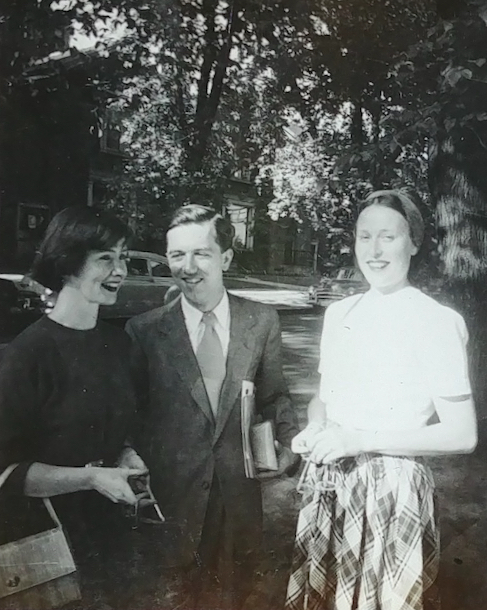
Pamela Terry Beckwith, John Beckwith, and Colleen Thibaudeau (1960)
( ( 0 ) ) In this audio clip, soprano Katy Clark performs “Serenade” at Wordsfest November 5, 2023 in London, Ontario.
Yes we are that too: we are everything who feel it. Everything that has meaning has the same meaning as angels: these hoverers and whirrers: occupied with us. Men may be in the parkgrass sleeping: or be he who sits in his shirtsleeves every blessed Sunday: rasping away at his child who is catching some sunshine: from the sticky cloud hanging over the Laura Secord factory: and teetering on the pales of the green iron fence: higher up than the briary bushes. I pass and make no sound: but the silver and whirr of my bicycle going round: but must see them who don’t see: get their fit, man and child: let this elastic moment stretch out in me: till that point where they are inside and invisible. It is not to afterward eat a candy: picket that factory: nor to go by again and see that rickety child on the fence. When the band of the moment breaks there will come angelic recurrence.
Colleen Thibaudeau, 1977
“This Elastic Moment” is included in Colleen Thibaudeau’s The Artemesia Book(1991), available from Brick Books.
Our grateful thanks to translator Patricia Godbout, who created this French version of Colleen Thibaudeau’s poem for Ellipse magazine in 1990.
Élastique, ce moment
Oui, nous sommes aussi cela : nous sommes tout ce qui est sensible. Tout ce qui possède un sens possède celui des anges : qui planent et qui vrombissent : veillent sur nous. Des hommes dorment-ils dans l’herbe du parc : un homme s’assoit-il en bras de chemise tous les dimanches : parle d’une voix grinçante à son enfant qui s’amuse au soleil : perçant le nuage collant au-dessus de l’usine Laura Secord : chancelant sur les pieux de la clôture de fer peinte en vert : bien plus haut que les buissons d’églantier. Je passe sans bruit : mais l’argent mais le vrombissement des roues de ma bicyclette : je dois voir qui ne me voit pas : prendre la mesure de l’homme et de l’enfant : laisser ce moment élastique s’étirer en moi : jusqu’à ce qu’ils soient intérieurs, invisibles. Nul besoin d’aller ensuite manger des friandises : ni de dresser des piquets devant l’usine : ou de repasser par là pour apercevoir l’enfant vaciller sur la clôture. Une fois brisé l’élastique du moment, viendra le retour angélique.
(Traduit par Patricia Godbout, (1990) Ellipse. (44) 99.)
Colleen Thibaudeau at the Writing in Our Time poetry conference in 1979, Vancouver, BC (Photo by Michael Lawlor)
Lights from the Highway sparser, softer now and the Gorst lights gone and their house gone away, just lost rib to new life in dark seas, just dark seven sleepers gone seasabout the foot of our hill, just the foot of the hill and a great cave opening up.
Lights from the glass cupboard !spark! the house dark; And it’s up to the glass cupboard now! It looms at James’ headheight, three paces from the kitchen sink, one from table, length approximately my armspan, crafted by an Albertan who loved the bush, the hills.
The Bay Highway kindles to blue Italian grotto glasses; and green glasses, safe-and-wide as Sweden; and cheap little ruby liqueurs sing; and cocktail Libbys supermart violent and fresh from fists that swung axes, pounded down a territory and rolled Malcolm Lowry into the soundmad surf dazzling no warning…
By an Albertan who loved the bush, the hills, who made this cupboard ark that tends the tides of dream. They light, they guard the house, glow like an icon of Mike Todd, thirty-odd glasses, touched off by random headlights moving toward the Bay.
I looked up suddenly and the sky was full of them, sky was on fire with them.
Following her directions I find the purple maple walk the mosslog deeper into the bush veer at the rushes test for sinkholes crawl the rabbitdropping undergrowth straighten up and the sky is full of them, sky is on fire with them.
(got the fence up here a long story so it’s beginning to look like Story Book Farm after all after a lot of work also we’ve been laying in crab-apple jelly wild-grape jam wild-cranberry & the like and Arthur was into the chokecherries for the wine also I brandied some wild-plums which I will never do again as you have to pierce each dratted little plum with a needle it’s so nice to be settled in Do come & see us)
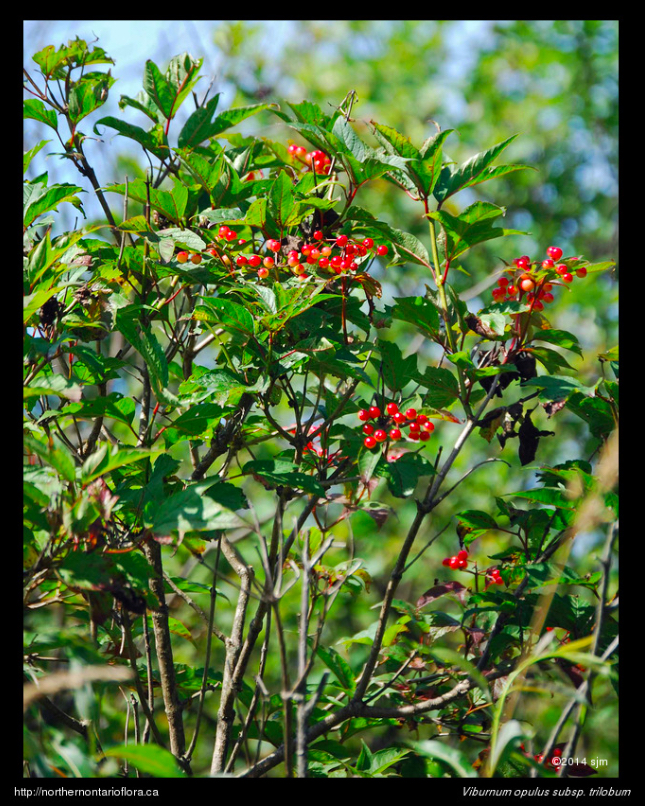
The Lake is directly in front of me but High Bush Cranberries swaying muddle up locations: dis mayme: dis turbme: dis locate
years of the instinctive glance for bears over the shoulder I begin picking, shouting out to Burning Lake:
This is only Watergate Year It’s not Year Whole World on Fire Not that Year yet.
Colleen Thibaudeau, 1974
“Getting the High Bush Cranberries” is from The Artemesia Book (1991), available from Brick Books.
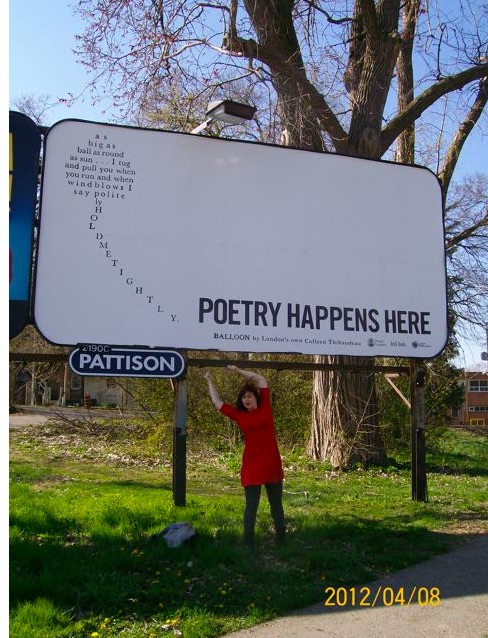
“Balloon” also appears in The Wind Has Wings: Poems From Canada (1968, Oxford University Press) and A Poke In The I — A Collection of Concrete Poems (2001, Candlewick Press).
In this poem, Thibaudeau directs readers to read it in two ways to produce two unique poems:
(1) One puddle in the lane looks clear down to Picardy Sees worlds deep stones like red blood flowers white bones Clear common brown drop lives washed (by) tears forever bones (in) Picardy.
(2) One sees clear puddle worlds common in deep brown the stones drop lane like lives looks red washed clear blood (by) tears down flowers forever to white bones Picardy bones (in) Picardy.
Markdale, Ontario in 1916: John Stewart Thibaudeau (Colleen’s father) with his mother, father, and youngest brother.
Written in 1968, “Going Straight Across the Lines then Down Each Column till it’s Finished” was first published in Air 13.14.15 in 1973 and then in The “Patricia” Album and other poems (1992), published by Moonstone Press.
Colleen Thibaudeau alludes to her father’s military service in France (1916-1919) in this note from The “Patricia” Album: “Not being from the Souwesto Region originally, I still see it as “other”. I am not surprised when I read in The London Free Press about “the men from Erieau”, some of whom would have been among those who looked down the lane to Picardy.”
Colleen Thibaudeau in Vancouver, BC, 1969. Photo by Pat Yeomans.
Thibaudeau’s use of free verse forms and concrete poetry came from her French literature studies at university. For example, French symbolist poetStéphane Mallarmé (1842-1898) described the space around words and groupings of words in a free verse or prose poem as necessary separations that direct the reader’s movement through it, much like “… Music as it is heard at a concert….”:
“Quite a few techniques found [in Music] seem to me to belong to Letters, and so I pick them up. Let the genre become one like the symphony, little by little, beside the personal declamation, leaving ancient verse intact – I venerate it and attribute to it the empire of passion and of dream – while it would be the time to treat, preferably, as it follows naturally, subjects of pure and complex imagination or intellect, not to exclude them from Poetry – the unique source.” — Stéphane Mallarmé from the Preface to Un coup de dés n’abolira jamais le hazard / Dice Thrown Never Will Annul Chance (1897) [English translation by Mary Ann Caws, 1981].
(See also Colleen Thibaudeau’s 1973 poem“From Verlaine’s Impressions” – a transliteration of Paul Verlaine’s “Impression fausse”.)
Women in Concrete Poetry: 1959-1979, a new collection from visual arts publisher Primary Information, includes Colleen Thibaudeau’s concrete poems from her 1965 book Lozenges: Poems in the Shapes of Things.
Inspired by Italian artist Mirella Bentivoglio’s exhibition of visual and concrete poetry by women at the 1978 Venice Biennale, editors Alex Balgiu and Mónica de la Torre have brought together 50 writers and artists from 17 countries to trace women’s use of this form during the period.
Thibaudeau’s earlier work used free verse forms, and an interest in concrete poetry came perhaps from her French literature studies and poet Guillaume Apollinaire’s (1880-1918) Calligrammes:
The Calligrammes are an idealisation of free verse poetry and typographical precision in an era when typography is reaching a brilliant end to its career, at the dawn of the new means of reproduction that are the cinema and the phonograph. [Apollinaire in a letter to André Billy, 1916] https://en.wikipedia.org/wiki/Calligrammes
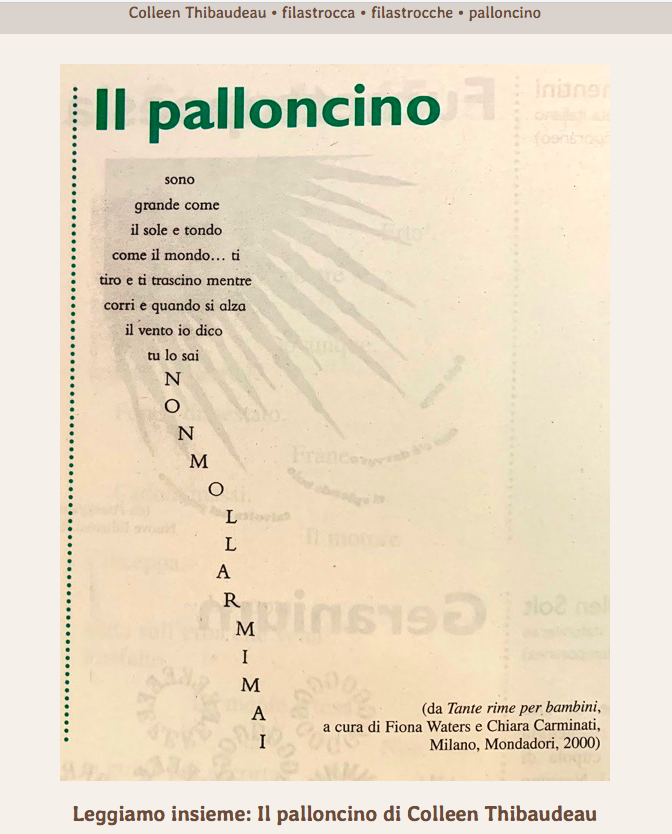
Conceived as a small format book, Lozenges: Poems in the Shapes of Things draws on everyday themes and objects from children’s lives – bell, ball, hockey stick, balloon – and invites readers old and young to discover the picture the words make.
Colleen’s book of concrete poems, Lozenges: Poems in the Shapes of Things, was published in 1965 by Alphabet Press in London, Ontario. Her husband James Reaney (1926-2008) typeset the poems and also designed the cover.
The sea gone girl is all at sea Stockings rolled below the knee, Careless slung the dishtowel hung Cat got its parting scatscatscat,– For her the very breeze of a Marine Was signal for abandoning.
The screendoor bangs, the little street Is window-wide a-buzz with her retreat: She makes it to the sad hotel Is keel-hauled by the firebell pull In lobby; then she rises to the tropic Islands rolling home in beer and frolic.
Others have that bleached hair, part ‘done’ Part rendered just uncombable by wind & sun, Others wear fishnet gowns in this and other towns, Have nails like Turner sunsets going down, Knuckles that are wrinkled as a fishwife’s bum, Have voices stored in shells that make a deepsea hum.
But who else has three captive princesses Mild-mannered, magical, wearing middy dresses? The six-year-old has her bath drawn ready, The seven-year-old holds the coffee-pot steady, & the eight-year-old draws the net of her nightdress over her head And casts the sea gone mother into bed.
Colleen Thibaudeau, 1957
“Sea Gone Girl” can be found in The Artemesia Book (1991), available from Brick Books.
((( o ))) Listen to Peggy Roffey read the poem here.