• Biography
  • Publications
  • Contact
  • Links

Colleen Thibaudeau

  • Going Straight Across the Lines then Down Each Column till it’s Finished

    February 17th, 2021

    In this poem, Thibaudeau directs readers to read it in two ways to produce two unique poems:

    (1)
    One puddle in the lane looks clear down to Picardy
    Sees worlds deep stones like red blood flowers white bones
    Clear common brown drop lives washed (by) tears forever bones (in) Picardy.

    (2)
    One sees clear
    puddle worlds common
    in deep brown
    the stones drop
    lane like lives
    looks red washed
    clear blood (by) tears
    down flowers forever
    to white bones
    Picardy bones (in) Picardy.

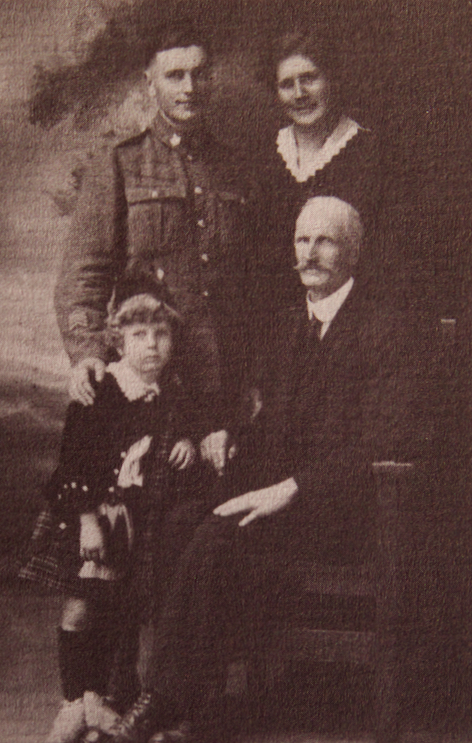
    Markdale, Ontario in 1916: John Stewart Thibaudeau (Colleen’s father) with his mother, father, and youngest brother.

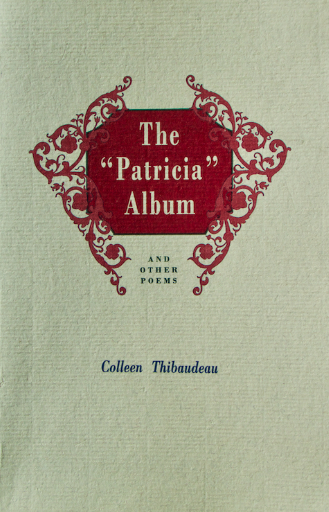
    Written in 1968, “Going Straight Across the Lines then Down Each Column till it’s Finished” was first published in Air 13.14.15 in 1973 and then in The “Patricia” Album and other poems (1992), published by Moonstone Press.

    Colleen Thibaudeau alludes to her father’s military service in France (1916-1919) in this note from The “Patricia” Album: “Not being from the Souwesto Region originally, I still see it as “other”. I am not surprised when I read in The London Free Press about “the men from Erieau”, some of whom would have been among those who looked down the lane to Picardy.”

    Colleen Thibaudeau in Vancouver, BC, 1969. Photo by Pat Yeomans.

    Thibaudeau’s use of free verse forms and concrete poetry came from her French literature studies at university. For example, French symbolist poet Stéphane Mallarmé (1842-1898) described the space around words and groupings of words in a free verse or prose poem as necessary separations that direct the reader’s movement through it, much like “… Music as it is heard at a concert….”:

    “Quite a few techniques found [in Music] seem to me to belong to Letters, and so I pick them up. Let the genre become one like the symphony, little by little, beside the personal declamation, leaving ancient verse intact – I venerate it and attribute to it the empire of passion and of dream – while it would be the time to treat, preferably, as it follows naturally, subjects of pure and complex imagination or intellect, not to exclude them from Poetry – the unique source.”
    — Stéphane Mallarmé from the Preface to Un coup de dés n’abolira jamais le hazard / Dice Thrown Never Will Annul Chance (1897) [English translation by Mary Ann Caws, 1981].

    (See also Colleen Thibaudeau’s 1973 poem “From Verlaine’s Impressions” – a transliteration of Paul Verlaine’s “Impression fausse”.)

  • Colleen Thibaudeau featured in Women in Concrete Poetry 1959-1979

    October 1st, 2020
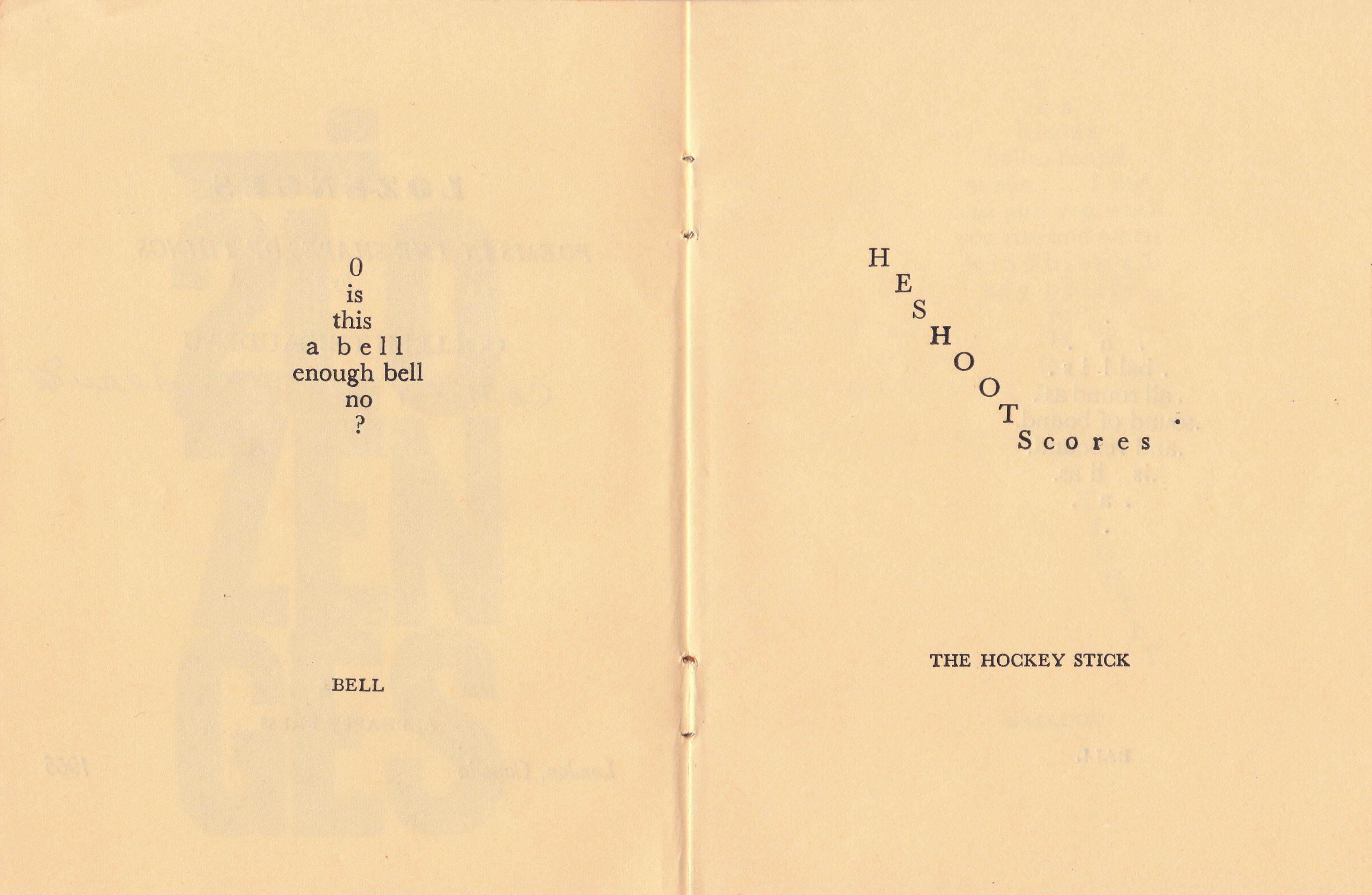
    “Bell” by Colleen Thibaudeau (1965)

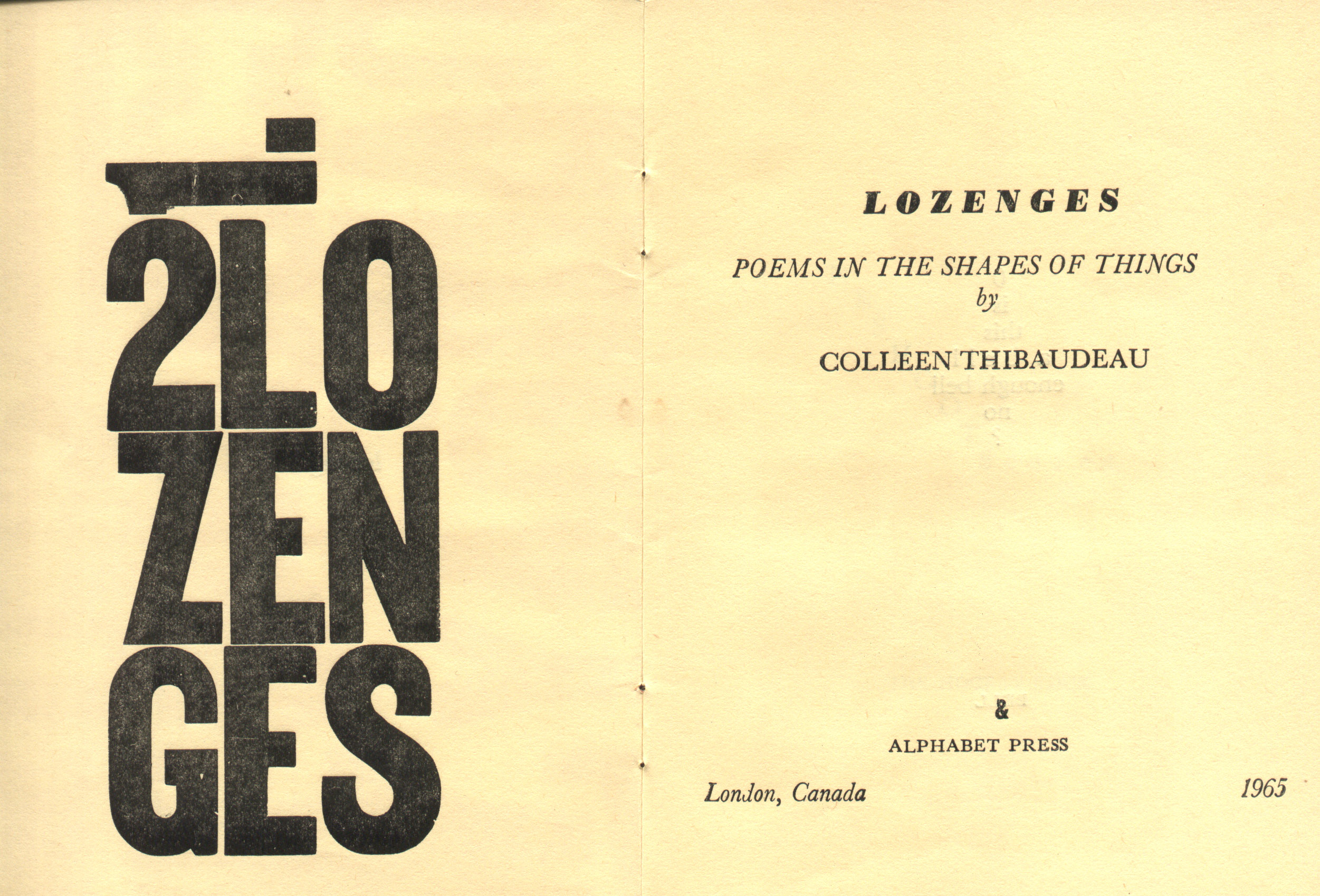
    Women in Concrete Poetry: 1959-1979, a new collection from visual arts publisher Primary Information, includes Colleen Thibaudeau’s concrete poems from her 1965 book Lozenges: Poems in the Shapes of Things. 

    Inspired by Italian artist Mirella Bentivoglio’s exhibition of visual and concrete poetry by women at the 1978 Venice Biennale, editors Alex Balgiu and Mónica de la Torre have brought together 50 writers and artists from 17 countries to trace women’s use of this form during the period.

    Women in Concrete Poetry 1959-1979 brings together a range of graphic, textual, and photographic approaches to poetic works: https://primaryinformation.org/product/women-in-concrete-poetry-1959-1979/

    Thibaudeau’s earlier work used free verse forms, and an interest in concrete poetry came perhaps from her French literature studies and poet Guillaume Apollinaire’s (1880-1918) Calligrammes:

    The Calligrammes are an idealisation of free verse poetry and typographical precision in an era when typography is reaching a brilliant end to its career, at the dawn of the new means of reproduction that are the cinema and the phonograph. [Apollinaire in a letter to André Billy, 1916] https://en.wikipedia.org/wiki/Calligrammes

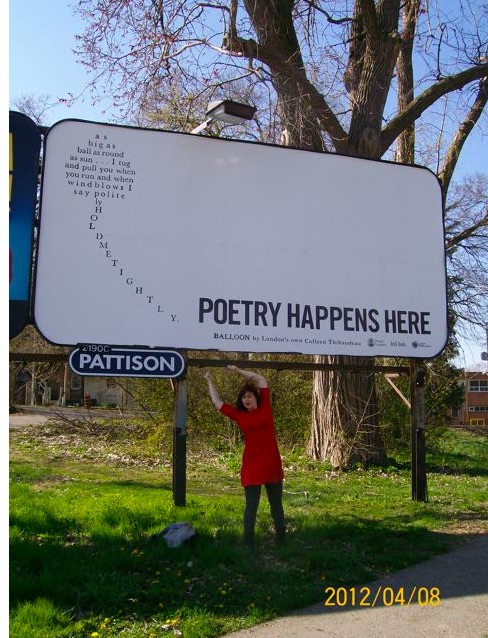
    Conceived as a small format book, Lozenges: Poems in the Shapes of Things draws on everyday themes and objects from children’s lives – bell, ball, hockey stick, balloon – and invites readers old and young to discover the picture the words make.

    “Balloon” by Colleen Thibaudeau (1965)

    View the original Lozenges poems here: https://colleenthibaudeau.com/2013/11/26/lozenges-poems-in-the-shapes-of-things/

    Women in Concrete Poetry: 1959-1979 is available from PrimaryInformation.org
    https://primaryinformation.org/product/women-in-concrete-poetry-1959-1979/

  • Lozenges: Poems in the Shapes of Things

    September 15th, 2020

    Colleen’s book of concrete poems, Lozenges: Poems in the Shapes of Things, was published in 1965 by Alphabet Press in London, Ontario. Her husband James Reaney (1926-2008) typeset the poems and also designed the cover.

  • Poem: “The Boy Actors”

    April 5th, 2020

    The Boy Actors

    She held her part,
    (Though knew the lines by heart)
    But the others hovering in the wings
    Obscured sure things.

    She let a page fall (no hurt)
    To pleach her skirt.
    Truly the part made her head whirl
    To act-a-girl act-a-boy act-a-girl.

    Colleen Thibaudeau, 1945

    “The Boy Actors”, written during Thibaudeau’s university days, appeared in Alphabet, Issue 1, 1960 under the pseudonym M. Morris.

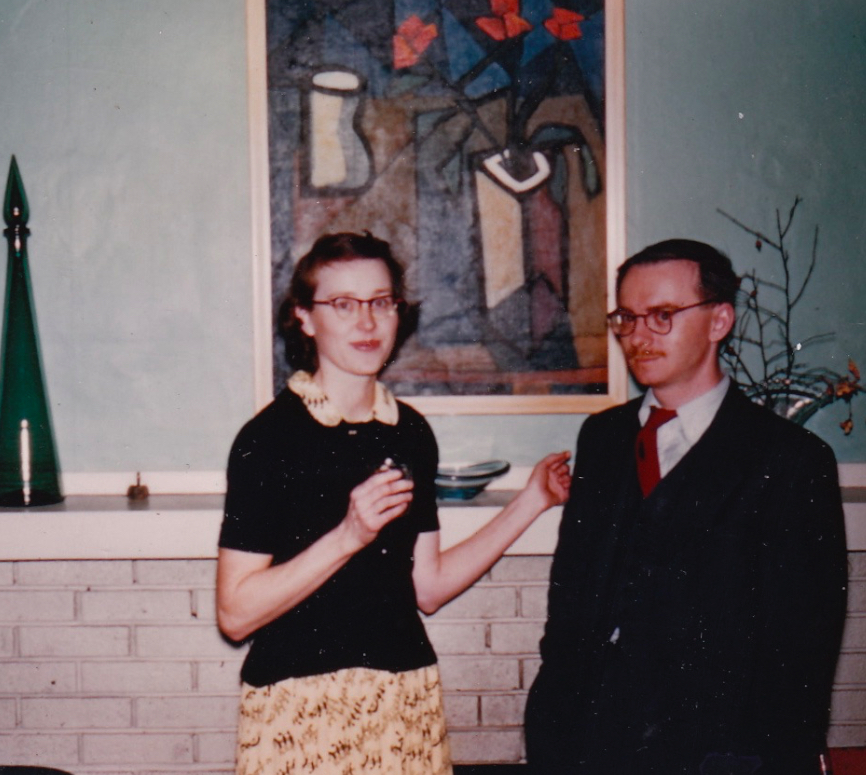
    1957, Winnipeg, Manitoba: Colleen Thibaudeau with her husband James Reaney.

  • Colleen Thibaudeau’s “Sea Gone Girl”

    February 10th, 2020

    Sea Gone Girl

    The sea gone girl is all at sea
    Stockings rolled below the knee,
    Careless slung the dishtowel hung
    Cat got its parting scatscatscat,–
    For her the very breeze of a Marine
    Was signal for abandoning.

    The screendoor bangs, the little street
    Is window-wide a-buzz with her retreat:
    She makes it to the sad hotel
    Is keel-hauled by the firebell pull
    In lobby; then she rises to the tropic
    Islands rolling home in beer and frolic.

    Others have that bleached hair, part ‘done’
    Part rendered just uncombable by wind & sun,
    Others wear fishnet gowns in this and other towns,
    Have nails like Turner sunsets going down,
    Knuckles that are wrinkled as a fishwife’s bum,
    Have voices stored in shells that make a deepsea hum.

    But who else has three captive princesses
    Mild-mannered, magical, wearing middy dresses?
    The six-year-old has her bath drawn ready,
    The seven-year-old holds the coffee-pot steady,
    & the eight-year-old draws the net of her nightdress over her head
    And casts the sea gone mother into bed.

    Colleen Thibaudeau, 1957

    “Sea Gone Girl” can be found in The Artemesia Book (1991), available from Brick Books.

    ((( o ))) Listen to Peggy Roffey read the poem here.

  • Colleen Thibaudeau’s “Notes on a Day”

    February 2nd, 2019


    In this poem, Colleen Thibaudeau recalls a temporary job she had at the University of Toronto library in 1948 and an early encounter with the poet Margaret Avison (1918-2007), who worked at the order desk.

    Margaret Avison was the first Writer-in-Residence at the University of Western Ontario in 1972. The Writer-in-Residence program celebrates its fiftieth anniversary this fall: https://www.uwo.ca/english/people/past_writersinresidence.html

    Notes on a Day

    Came back from searching dental periodicals
    in the Russian translated into German stacks,
    Office was feathered over with soft acquisitions
    and Our Boss was pondering the Great Seal prior
    to attack on new Books. I asked for a change of task.
    ‘Four o’clock. Not a good time to start fresh.
    Try Boston. Try the French …’
    Suddenly Margaret, at her desk, looking no different
    said, ‘Tether: end of.’ No word more,
    passed solitary angel out the gothic door.

    Well, yes: Go up: go down. Try Boston. Work to rule.
    Came back from searching dental periodicals
    in the Russian translated into German stacks.
    Our Boss cooed ‘Migraine weather’
    put away till tomorrow the Great Seal.
    Going home I passed through Chinatown
    and bought one of those pink folded-up flowers
    that once in water pulses like a throat,
    then skipped to ailing Maggie’s doorstep, Whistled
    something delightful to the tune of:
    ‘And particularly delightful is the story of the little old
    man who rode all over Moscow free because 
    no one could change his hundred rouble note.’

    Colleen Thibaudeau, 1977

    More about Colleen Thibaudeau’s friendship wth Margaret Avison

    An admirer of Avison and her poetry, Thibaudeau began work on her MA thesis on “Recent Canadian Poetry” later that fall. They became further acquainted when Northrop Frye took them out to lunch, and as he notes in his diary, “… I think Margaret & she really took to each other.” [See The Diaries of Northrop Frye 1942-1955, Volume 8, 1949 Mar. 28; this is the lunch Thibaudeau describes in the Biographical Sketch from 1979.]

    See also the special issue of Canadian Poetry, Nos. 80-81 for the centenary of Margaret Avison’s birth, where Stan Dragland recalls Margaret and Colleen meeting again in 1973 and Margaret saying ‘I’m going Colleening!’… “Margaret caught [Colleen’s] dynamism in a single word. I’m very glad to have been on the spot to hear that word invented; otherwise, it might never have been spoken. And, speech being so evanescent, it might have been lost… Colleening: The Poetry and Letters of Colleen Thibaudeau is now the title of a play by Adam Corrigan Holowitz, with music by Stephen Holowitz and Oliver Whitehead.” (page 43)

    For more about the working milieu of the library order desk from the time described in Thibaudeau’s poem, see Margaret Avison’s I Am Here and Not Not-There: An Autobiography (2009), pages 111-114.

    “Notes on a Day” is from The Artemesia Book (1991), available from Brick Books.
    Margaret Avison in 1973 — Family photo (I Am Here and Not Not-Here: An Autobiography, page 191)
  • Colleen Thibaudeau’s “from Verlaine’s Impressions”

    June 13th, 2018

    from Verlaine’s Impressions

    Mrs. Trott Mouse
    black in the greyed-out time
    Mrs. Trott Mouse
    greyed-out in the blackness

    Bell’s ringing:
    go to sleep little prisoners
    Bell’s ringing:
    just go to sleep

    No bad dreams now
    Ne pensez qu’à vos amours
    No bad dreams now
    Des belles toujours

    Big clear moonlight
    snug snoring
    Big clear moonlight
    really

    A shadow’s passing over
    it’s gone black as an oven
    A shadow’s passing over
    Suddenly it’s morning.

    Mrs. Trott Mouse
    rose in the blue rays
    Mrs. Trott Mouse
    get up sleepyheads.

    Colleen Thibaudeau, 1973

    ((( o ))) In this audio clip from 1997, Colleen Thibaudeau describes how she created her “transliteration” of Paul Verlaine’s “Impression fausse”:

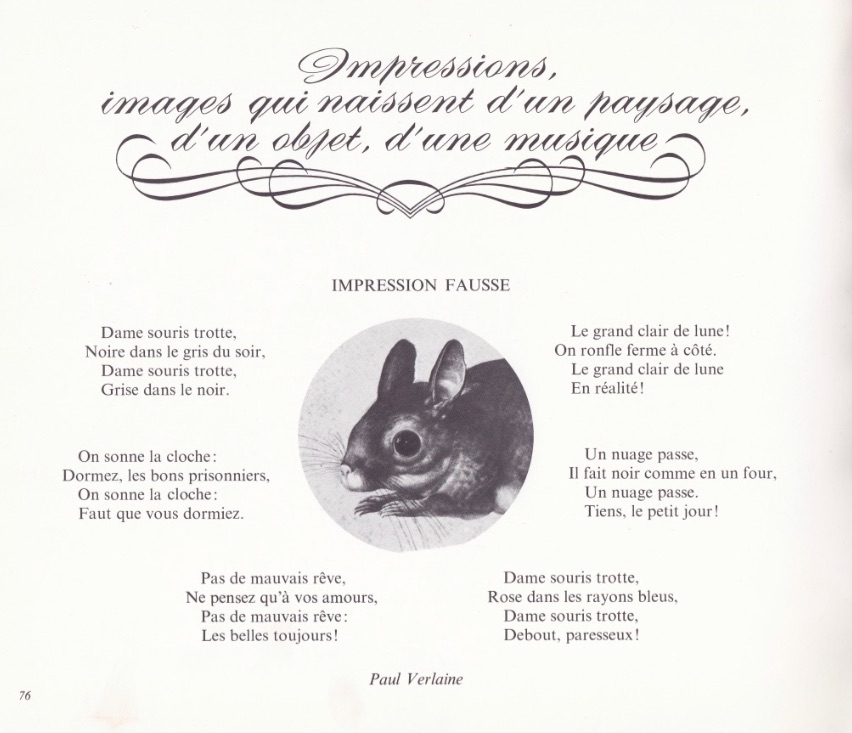
    Paul Verlaine’s “Impression Fausse”, Premier livre de poésie, page 76.

    Thank you Peggy Roffey for reuniting the long lost copy of Premier livre de poésie with Colleen’s family and sharing the 1997 interview with Colleen Thibaudeau at “Voicing Colleen”.

    Premier livre de poésie, published by Gautier-Languereau, 1970

    From the Biographie des poètes, page 89:

    VERLAINE (Paul) (1844-1896).
    C’est un des premiers grands poètes formés  par l’école symboliste. Son oeuvre sincère, émouvante, est avant tout une musique et correspond bien au but des symbolistes qui était d’évoquer sensations et sentiments.


  • “Voicing Colleen” at the London Public Library

    May 22nd, 2018


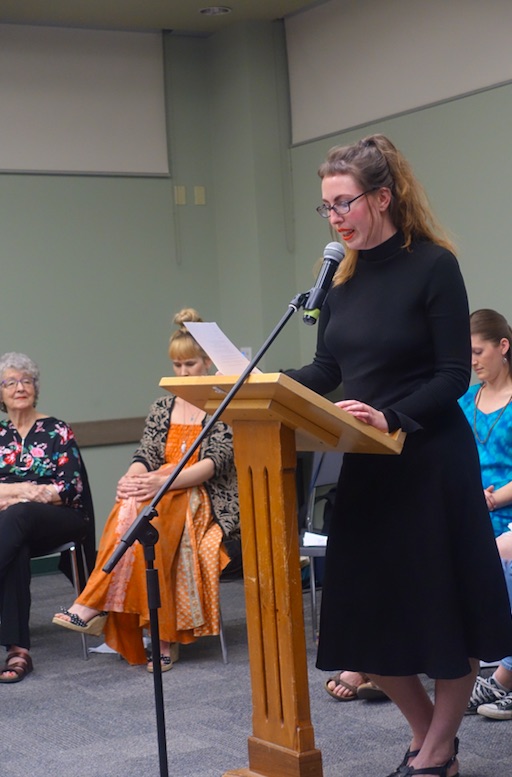
    Voicing Colleen at the London Public LIbrary: James Stewart Reaney and Susan Reaney (Colleen’s children) read Thibaudeau’s poem “Looking at The Artemesia Book”. (All photos from this event are  by Cameron Paton.)

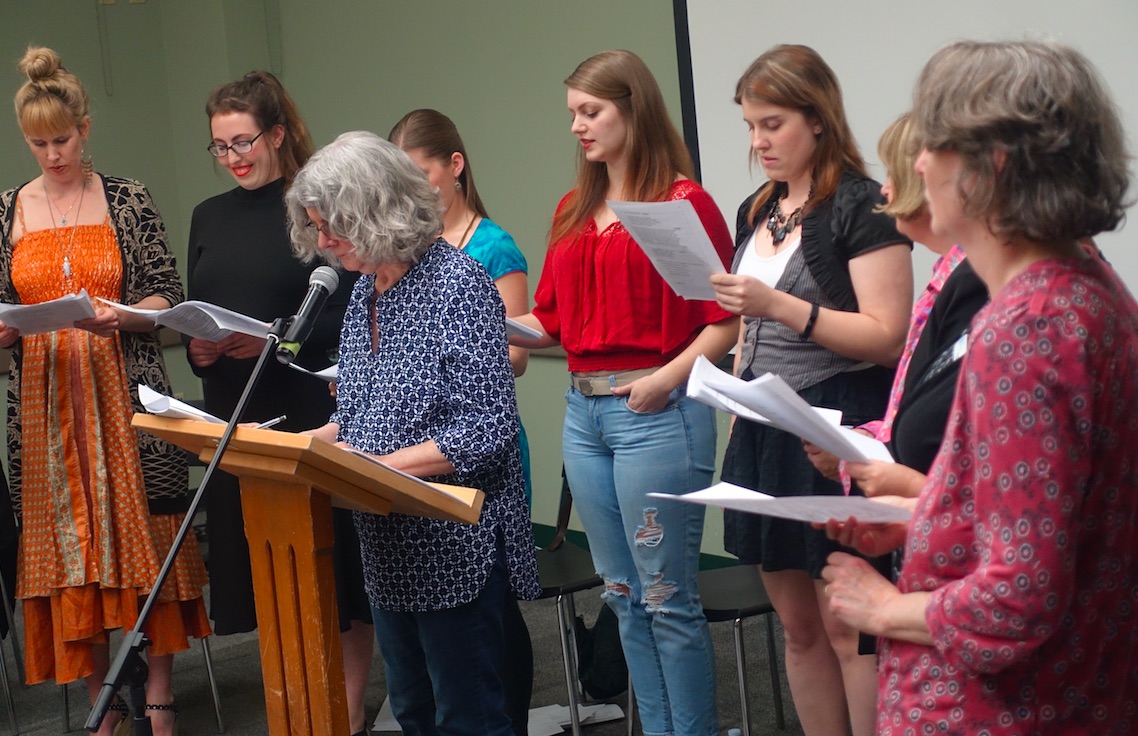
    Thank you all for joining us on Monday May 7th at the The London Public Library‘s Stevenson & Hunt Room for “Voicing Colleen” — an evening of poetry by Colleen Thibaudeau.

    Host Peggy Roffey chose 33 of Thibaudeau’s poems read by  a choir of voices — some solo, some shared, some with the audience. Unique to this evening was the chance to hear the ten poems in Thibaudeau’s elegiac sequence “Ten Letters” read by ten different voices.

    Voicing Colleen: Jean McKay leads on “I do not want only” accompanied by Kelly Creighton, Angie Quick, Kelly McConnell, Koral Scott, Brittany Renaud, Susan Wallace, and Susan Reaney.

    Angie Quick reads Colleen Thibaudeau’s poem “The Rose Family”.

    Thank you Peggy Roffey for organizing this event and inviting an intergenerational group of readers to voice Colleen’s work — Patricia Black, Kelly Creighton, Carolyn Doyle, Kelly McConnell, Jean McKay, Angie Quick, Brittany Renaud, and Koral Scott, along with members of Colleen Thibaudeau’s family — her son James Stewart Reaney, daughter-in-law Susan Wallace, and daughter Susan Reaney.

    Voicing Colleen: Left to right: Patricia Black and Kelly Creighton enjoy Susan Reaney and James Stewart Reaney reading “Looking at The Artemesia Book”.

    Special thanks to the London Public Library and Carolyn Doyle for including Colleen Thibaudeau in the “Women Trailblazers” series celebrating Canadian women writers. The series concludes on Monday May 28 at 7 pm with Judy Rebick and Penn Kemp reading from their new books.

    Brick Books has three titles by Colleen Thibaudeau: The Martha Landscapes (1984), Ten Letters (1975), and The Artemesia Book (1991), which are also available in e-book versions.


  • My granddaughters are combing out their long hair

    April 24th, 2018

    My granddaughters are combing out their long hair

    my granddaughters are combing out their long hair sitting at night
    on the rocks in Venezuela       they have watched their babes
    falling like white birds from the last of the treetop cradles
    they have buried them in their hearts where they will never forget
    to keep on singing them the old songs

    brought down to earth they use twigs, flint scrapers acadian
    their laughter underground makes the thyme flower in darkness

    my granddaughters are thin as fishbones & hornfooted but they are
    always beautiful under the stars: like little asian paperthings
    they seem to open outward into their own waterbowl

    mornings they waken to Light’s chink ricocheting
    off an old Black’s Harbour sardinecan.

    Reduce them the last evangelines make them part of the stars.

    my granddaughters are coming out by night combing their burr
    coloured hair by the rocks and streamtrickle in Venezuela
    they are burnt out as falling stars but they laugh
    and keep on singing them the old songs.

    Colleen Thibaudeau, 1977

    “My granddaughters are combing out their long hair” is from The Artemesia Book (1991), available from Brick Books( ( (o) ) ) Listen to Peggy Roffey read the poem here.

  • Idea for an Elegy: Finished up for the Brinks

    February 10th, 2018
    Colleen (on the right) with a friend at the Broughdale skating rink, London, Ontario, January 1966.

    Idea for an Elegy: Finished up for the Brinks

    Behind St. Peters strolls the cinderpath
    a hazy day and two nuns pass (I stand by):
    One has a face like a freckled egg, Irish, and accented
    I would say straight Sandwich or some border town;
    the other older sallower Belgian-born from La Salette—
    Joyful their four eyes soar and won’t cast down—
    ‘So many more gulls. So many strange gulls.
    So many strange gulls. More since the Seaway …’
    when they turn off toward the grotto it is as damp
    as if they had dumped the grotto down on the riverbank.

    Five o’clock
    is calling the lost hours home:
    Fly back! calls Middlesex
    Right now! calls St. Peter’s
    Bell towers take the time from glint of wings
    clear up the Thames. My wheels are still silver
    on the cinderpath … those gulls are abundant, beady eyes
    that have taken in Detroit, insouciance of Montreal;
    multitudes of gulls, freckled, fresh-starched,
    travel creased or whatever
    (So many strange gulls. Up from the Seaway.)
    take up a sad calling:
    Of Sylvia Plath. O Sylvia Plath.

    Colleen Thibaudeau, 1967


    Colleen’s poem appears in The Artemesia Book (1991), available from Brick Books.

    (((o))) Listen to Peggy Roffey read “Idea for an Elegy” here.


←Previous Page
1 2 3 4 5 6
Next Page→

Blog at WordPress.com.


Loading Comments...
 

    • Subscribe Subscribed
      • Colleen Thibaudeau
      • Already have a WordPress.com account? Log in now.
      • Colleen Thibaudeau
      • Subscribe Subscribed
      • Sign up
      • Log in
      • Report this content
      • View site in Reader
      • Manage subscriptions
      • Collapse this bar