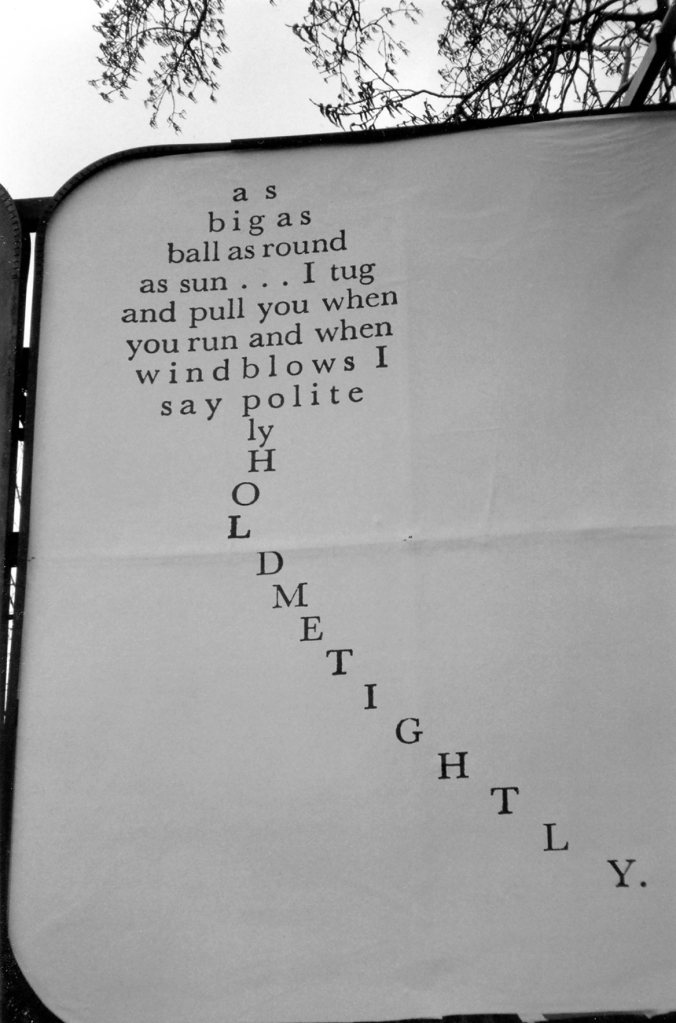
Colleen Thibaudeu’s poem “Balloon” from Lozenges: Poems in the Shapes of Things (1965)
( ( ( 0 ) ) ) In this video, London poet Karen Schindler recalls the 2012 billboard-size version of “Balloon”on Wortley Road at Antler River Poetry’s 2025 event Colleen Thibaudeau: An Evening of Poetry and Memories: https://www.youtube.com/shorts/HlciA825ZiM
April 14, 2012: “Balloon” by Colleen Thibaudeau mounted on a billboard at Wortley Road in London, Ontario for National Poetry Month.
“Balloon” is from Colleen Thibaudeau’s 1965 book Lozenges: Poems in the Shapes of Things, and has appeared in the poetry anthologies The Wind has Wings (1968), A Poke in the I (2001), and in Italian in Tante rimi per bambini (Mondadori, 2000).
The Little One Reads the Almanac (from Francis Jammes)
The Little One is reading the Almanac & sitting near the egg cartons It’s all about Saints and Famous Men and what’s coming weather-wise, Too it’s about beautiful big Sky Signs: the Goat, the Bull, the Ram, the Fishes etc.
Perhaps she can believe, the Little One, That way above her in the Constellations There are markets like this one with donkeys Bulls, Rams, Goats, with Fishes.
O yes she’s reading about Sky Market And when the page is all about the Scales She can say to herself: why Sky Market is just like the grocery store Where they weigh out the coffee, the salt and the Consciences.
Colleen Thibaudeau, 1973
“The Little One Reads the Almanac” is from Colleen Thibaudeau’s 1977 book My granddaughters are combing out their long hair, published by Coach House Press.
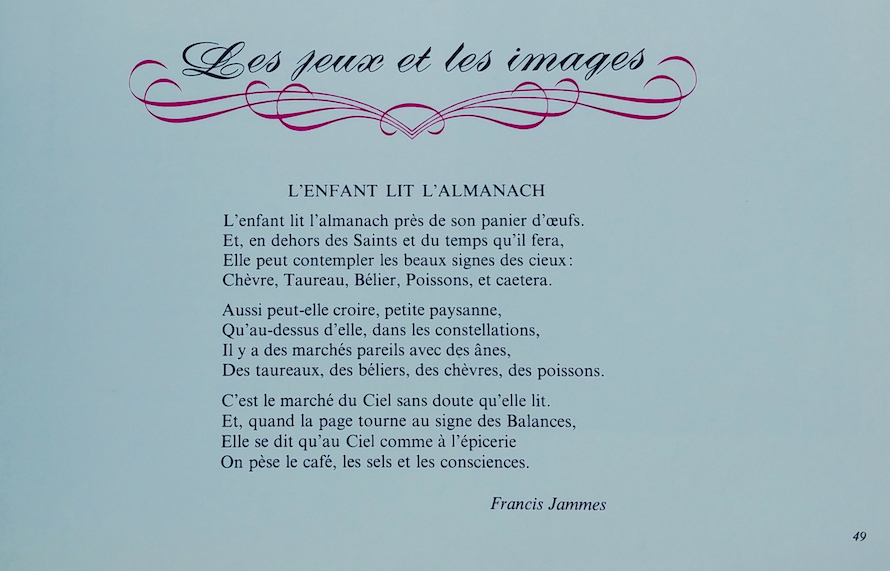
Based on Francis Jammes’ (1868-1938) poem “L’enfant lit l’almanach,”Thibaudeau would call this a “transliteration” of the original French poem, rather than an exact translation. (See the earlier post “from Verlaine’s Impressions” and the audio clip where Thibaudeau describes her approach.)
Francis Jammes’ “L’enfant lit l’almanach,’, Premier livre de poésie, page 49.Premier livre de poésie, published by Gautier-Languereau, 1970
From the Biographie des poètes, page 86:
JAMMES (Francis) (1868-1938). Habitant les Pyrénées, Francis Jammes est resté en dehors des mouvements qui ont secoué la poésie au début du XXe siècle. Son art est simple, familier, mais profondément vrai et d’une grande sensibilité ; l’amour de la nature y apparaît constamment ainsi qu’un profond sens religieux.
I I look through a circular window: I make a frame of small twigs with budding leaves; Inside this the first spring skippers are jumping: Yellow and pink, yellow and pink. The soundless rhythm of their feet jumping Becomes visible as bubbles on this cup of tea.
II The grass-seed sower casts, casts, And behind her the birds come Greedy for her hopes. They are eating up This poem almost as quickly as I can make it.
III The long-legged man is again whistling As he goes early to work. Seen Through a basement bedroom window, he will always be recalled by boots and jeans, and the whistling that encircles him completely in his day’s dancing.
IV Anne Brontë’s grave is planted completely and mysteriously: “No one knows who tends it.” This time it is lined by yellow pansies, and fixes (for a short spell), our hammered-by-the-sea-winds straying thoughts.
V “The little island of the year,” my mother says and so from desert island it grows; populated by family: Family Reunion. Disquiet about estrangement motivates roots-out-of tumbleweed: annual habitation (strangely) magnets from a tiny stamp or the kiss that fixes it on the ‘just-a-reminder’ postcard.
December 3, 2025 — This poem by Colleen Thibaudeau was read by poet David White at Antler River Poetry’s event Colleen Thibaudeau: An Evening of Poetry and Memories.
My Grandmother’s Sugar Shell, Ontario Baroque
My grandmother’s sugar shell (spoon), Ontario Baroque, has just fallen out of the uncleaned silver bag. What does it mean, I wonder. One day only I saw her stop work. We lay out on the grass by the highway under the big maple and two cars went by toward Owen Sound. When she heard their car coming for dinner, she got up, a big woman with Scottish shoulders, built too heavy on the top like all the Stewarts, her leg-bones stilt-like in proportion to the square rest of her.
And she rose all of a piece, I remember that she rose up somehow straight and not hinging her knees, nor using her hands, nor her elbows, nor leaning her head forward. So that she was the reverse of a tree falling before a quick gust. That is, she rose on a slant as if pulleys were attached to her everywhere
or as if the kitchen woodstove were a magnet that suddenly drew her inside. One minute she was all green and gold lying there dappled. The next she was half-way up the lawn and in motion over the steps. The door opened magically and she disappeared. She would never wonder about anything, just say, “That spoon needs cleaning.” And yet I think it means she needs remembering.
As part of Colleening 2025, London’s Antler River Poetry group presented an evening of poets reading their favourite Colleen Thibaudeau poems and sharing their memories. Thank you Roy Geiger and Misha Bower for organizing the event and to readers John Tyndall, Jordan Williamson, Karen Schindler, Jennifer Wenn, Jenny Berkel, Peggy Roffey, David White, and Penn Kemp.
in the green oakgrove at Timesend’s is blowing a pink rose special to that shade: peculiar, wild and soft, not lasting, it has affinity with what my Dolphin Baby said to me: We’re all aswim in one big sea
out lying on the green grass beside the hedge and under the scrub oak trees, I was watching two children coming through the dust knee-high (and the bees were about and were zooming after those yellow warblers that go lacing through the hedge) and with never a sign they drifted over to the grove and snitched each one a whole banner of roses that they held close to their jerseys till they were nearly out of sight when suddenly they loosened up and began madly swinging roses. Then only the mid-day left very hot and I was listening to the wash-wash voice of my baby who was asleep and who suddenly said, We’re all aswim in one big sea.
O Joy, the lightest tap can stir a failing sun can give the labouring globe a spin that starts a staggering miraculous run of roses, trees and we and we who do all swim in one big sea.
Colleen Thibaudeau, 1954
Colleen Thibaudeau and her son James, King’s Park, Manitoba 1954.
On November 29, 2025, the James Reaney Memorial Lecture was given by poet Peggy Roffey, and the title of her lecture was Colleen Thibaudeau’s ‘Big Sea’ Vision. Inspired by Thibaudeau’s idea of how we are “all aswim in one big sea,” Roffey explained that “The poem shows how the affinity between the rose and what the baby says is created, and how that summer moment enters the speaker’s mind and memory.”
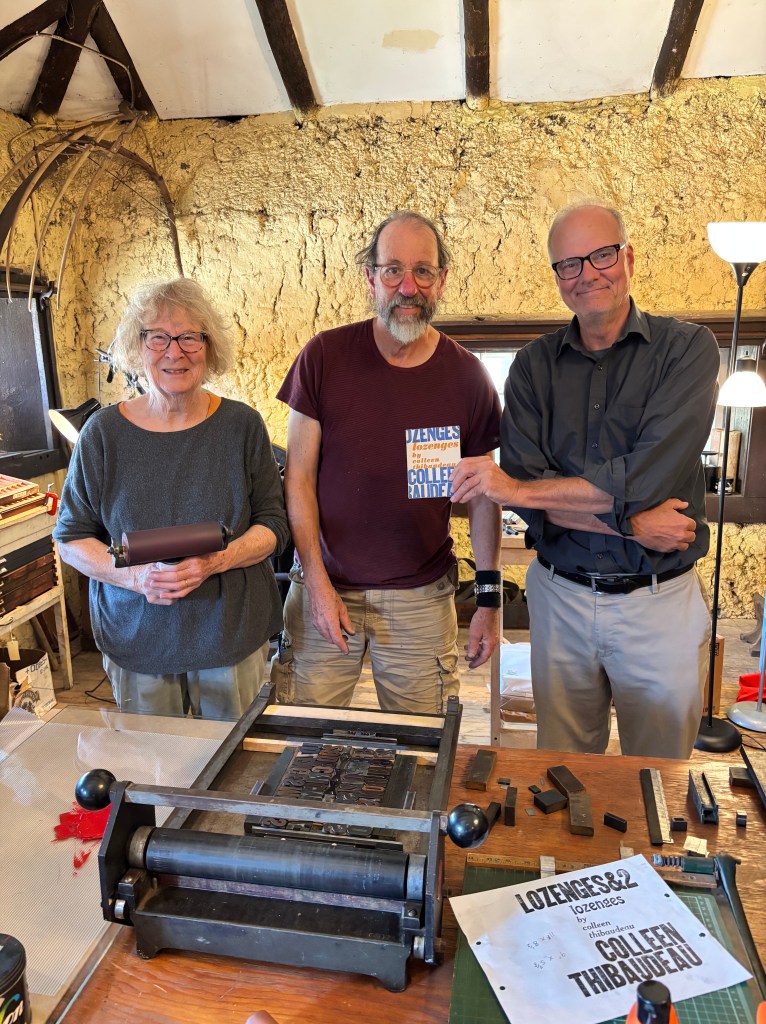
Printers Hilary Neary, Stephen Sword, and Mike Baker at The Forge and Anvil Museum in Sparta, Ontario. (Photo by James Stewart Reaney)
Wednesday August 27, 2025 — Printers and compositors Hilary Neary (left), Stephen Sword, and Mike Baker pose with Colleen Thibaudeau’s 1965 classicLozenges. A detail from the 2025 edition’s cover design is in the foreground at The Forge and Anvil Museumin Sparta, Ontario where the second edition was printed.
The Lozenges second edition is part of Colleening 2025, a celebration of the centenary of Colleen Thibaudeau (1925-2012).
( ( ( 0 ) ) ) Listen to Hilary Neary and Mike Baker read poems from Lozenges.
Colleen Thibaudeau’s poem “The Train” from Lozenges (1965)Colleen Thibaudeau’s poem “The Hockey Stick” from Lozenges (1965)
Colleen Thibaudeau (seated) with her friends, Summer 1943 in St. Thomas, Ontario. (Joyce Draper is on the left and June Rose is seated at the top.)
The Tin Shop
The Tin Shop never sounded tin it sounded canaries; because of the Great Depression no one wanted eaves but everyone wanted canaries.
It became the place where we changed skates sharpened them traced out our initials on the floor, sipped cocoa.
The Tinsmith bred canaries that lived in tin apartments elaborate as palaces spacious and filling all the upper air with communal sopranos.
The Tin Shop never sounded tin it became a meeting place for men displaced workers all their strength now gone into those deep voices vibrantly disaffected politically haranguing words / scored as deeply in the wooden floors as our skate blades.
The canaries sang and moulted a world of yellow. The men’s words, strong, bedevilled, are they in the end gone like the songs and the feathers?
Colleen Thibaudeau, 1984
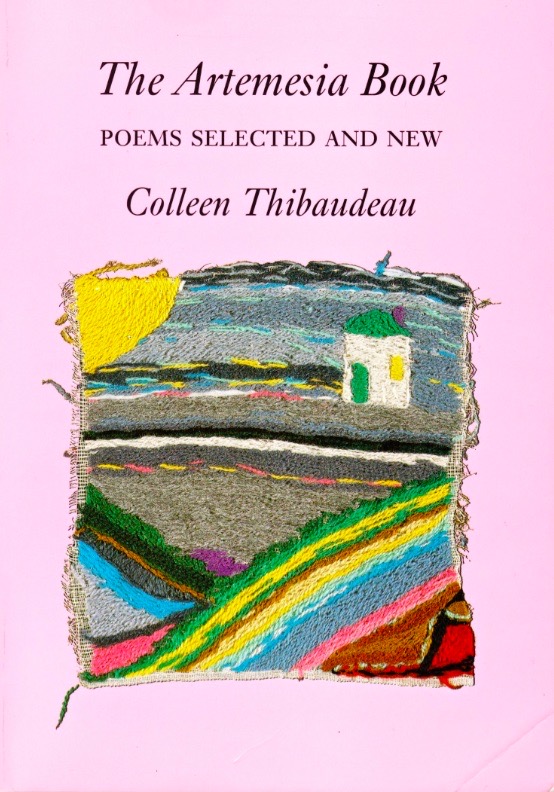
“The Tin Shop” first appeared in The Martha Landscapes (1984) and is also included in The Artemesia Book (1991), both available from Brick Books.
( ( ( 0 ) ) ) Listen to Steve Peters, the current owner of the Tin Shop, read Colleen Thibaudeau’s poem.
‘Going to be one hot summer for sure,’ said Uncle Willie who had set his heart on growing watermelons in a cindery patch at the very end of his Garden.
‘No one is going to look there for them.’ He told no one but us, planted them at night. Joyce and I biked sweatily out to our first job, tenderly
moved translucent baby cabbages, made little hats for them, carried water endlessly and longed for the promised crisp bite, the crisp juices
reviving, ‘turning us into real people’, he said. We were just at that turning point, thirteen years old; we dreamed of the watermelon promise.
He said they were ‘coming along nicely’, green taut, bulging over the hillside, as yet undiscovered by the boys. September came.
The boys came. One Saturday morning we saw yellowing leaves only and every watermelon gone. Yet the anticipation of the melon miracle
seemed to have turned us, Joyce and I, into ‘real people’. And we pondered this, purposely noisy with our milkshakes, solacing ourselves with second best.
Colleen Thibaudeau, 1991
“Watermelon Summer” is from The Artemesia Book (1991), available from Brick Books.
( ( ( 0 ) ) ) Listen to Sonja Gustafson perform the poem set to music by Stephen Holowitz.
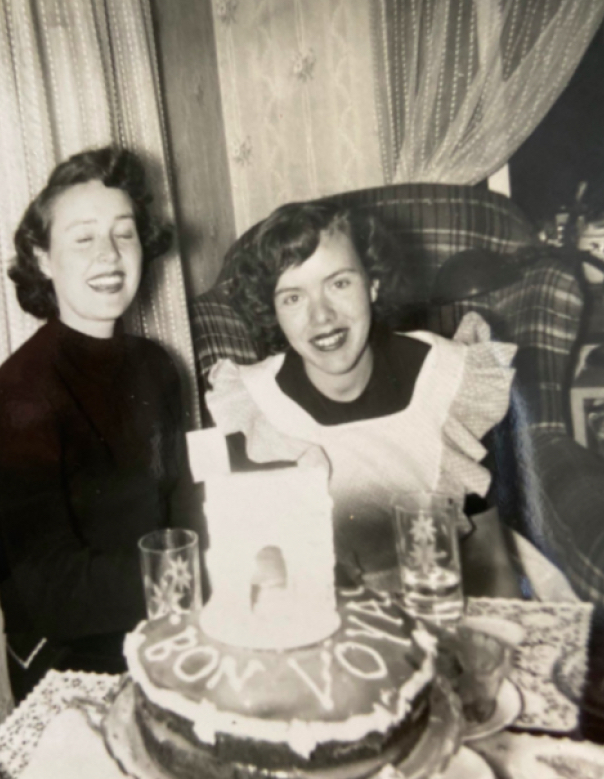
Long after the “Watermelon Summer,” Colleen and Joyce remained friends and Joyce grew up to be a talented artist. She once made a “bon voyage” cake (complete with arc de triomphe!) when Colleen left to teach in France.
Colleen Thibaudeau and Joyce Draper Coles, St. Thomas, Ontario, October 1950.Joyce’s 1946 exhibition at Central Tech in Toronto 1946 painting by Joyce Draper Coles (1925-2020) of her Toronto neighbourhood
The child who never lived was the real child whose lovely eyes were seas and little limbs were lullabies and lovely seas
He said, my mother is a street where strangers pass her hair winds like the wind round wooden poles
Her lovely eyes are seas Her hair is wind that shakes the elder tree
He said, my mother is a stair where strangers pass and when night rocks me round then I am sure
Her hair is wind that shakes the elder tree her eyes are seas
Colleen Thibaudeau, 1967
“Lullaby of the Child for the Mother” can be found in My granddaughters are combing out their long hair (Coach House Press,1977) and also in The Artemisia Book (1991), available from Brick Books.
( ( ( 0 ) ) ) Listen to Sonja Gustafson perform the poem set to music by Oliver Whitehead.
The blue of the Swimming Pool isn’t a real blue And there is no easy way to describe it as water; It transforms an ordinary backyard and the ordinary people Who roar up in trucks, sitting stunned for a moment Now that there is no longer the moving belt bearing them on; Getting unbelieving out of the tucks, setting up playpens, Getting undressed and into bathing suits and finally entering The Pool.
The Cat sits (while no one is looking) on the portulaca In the rock garden and looks at the people in the unbelievable Not real blue of the Swimming Pool. There are the very young Grandparents, their own married young and the spouses And the assorted babies of the married young. Muscular, Shining, joyous, the babies unafraid, they all accept the water Moment: fountain of life or very womb.
And the Cat looks on In the sharp sunlight and drinks in at the eye the not real blue Of the Swimming Pool and the swimmers transformed and moving Freely, ordinary and beautiful.










 Colleen Thibaudeau